What Are Vertical Asymptotes
Vertical asymptotes (often abbreviated to V.A.) are vertical lines that a function will approach (from one or both sides) and become infinitesimally close to, but will never touch. A more formal definition will be included below. For a function to have a vertical asymptote, the range must be infinitely large—that is, it must extend to negative and/or positive infinity.
Three general types of asymptotes exist: vertical asymptotes, horizontal asymptotes, and oblique asymptotes (also commonly called slant asymptotes). In this tutorial we will be focusing on vertical asymptotes.
There are a couple of different ways of visualizing the vertical asymptote. The most common analogy is to visualize it as an airplane approaching a brick wall and how the pilot will pull up/down to avoid a collision. Alternatively, you can just memorize the graph of 1/x and remember that all vertical asymptotes will look roughly the same (the function will either go up or down forever near the asymptote).
Vertical asymptotes exist at the x-value where the denominator of the function is zero and the numerator is non-zero.
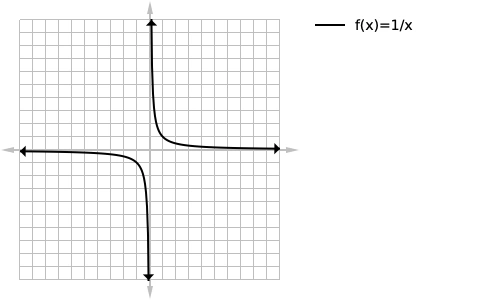
Figure 1: Graph of 1/x
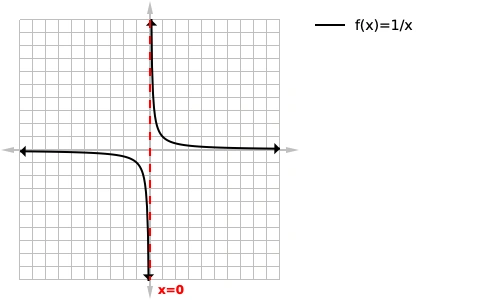
Visually we can see that the graph approaches but never reaches x=0 as shown with the dashed line:
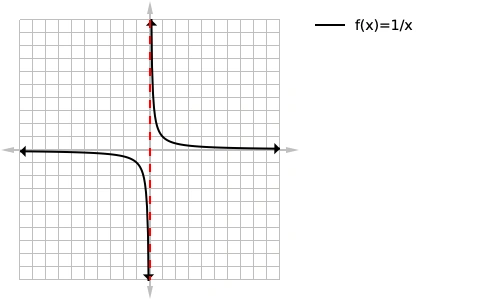
We then want to label our asymptote at the bottom of the page next to the asymptote with its equation:
A Table
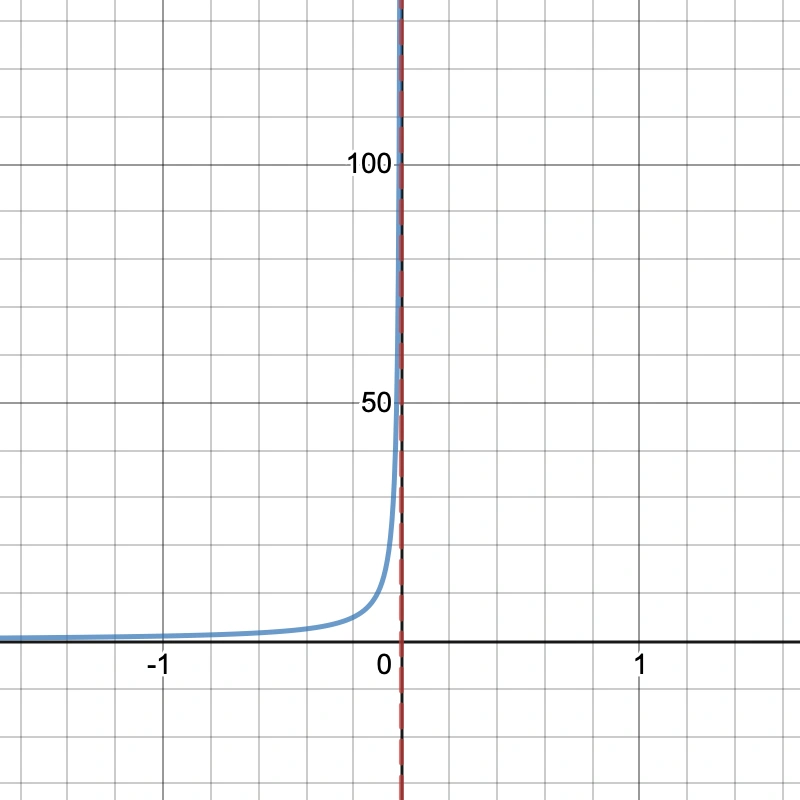
Below is a table of our function f(x) approaching our vertical asymptote but never reaching it from the left side. The same would apply to the right as well.
| f(x) | result |
|---|---|
| f(-1) | -1 |
| f(-0.1) | -10 |
| f(-0.01) | -100 |
| f(-0.001) | -1000 |
| f(-0.0001) | -10000 |
| f(-0.00001) | -100000 |
| f(-0.000001) | -1000000 |
| f(-0.0000001) | -10000000 |
As you can see from the table, our graph approaches infinity as we come close to our asymptote but we are never able to reach/touch/intersect with our asymptote.
If you are ever unsure if there is a vertical asymptote at a specific x-value, I would highly recommend making a table like the one above to verify that the function does in fact approach negative or positive infinity as we approach said value.
Limit Definition
A vertical line x=a (where a is any real number) will be a vertical asymptote of f(x) if any of the following limits are true:
From the left our function approaches infinity:
From the left our function approaches negative infinity:
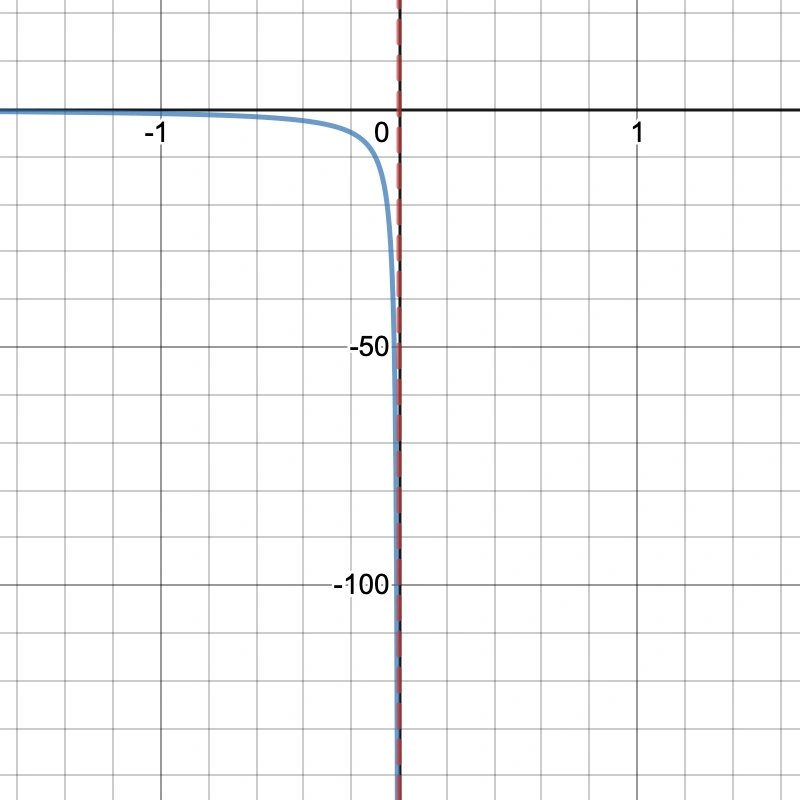
From the right our function approaches infinity:
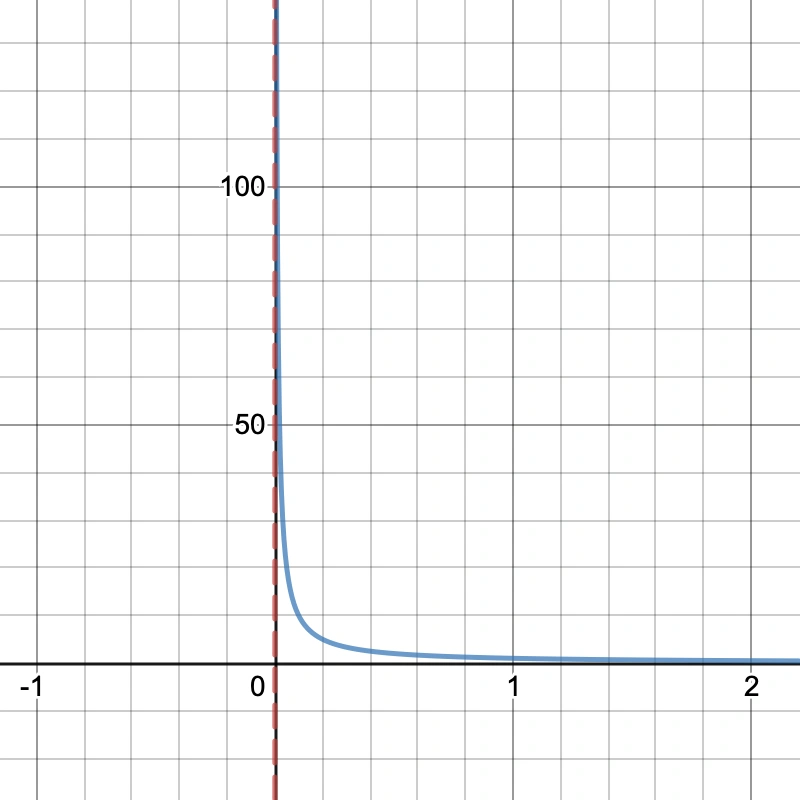
From the right our function approaches negative infinity:
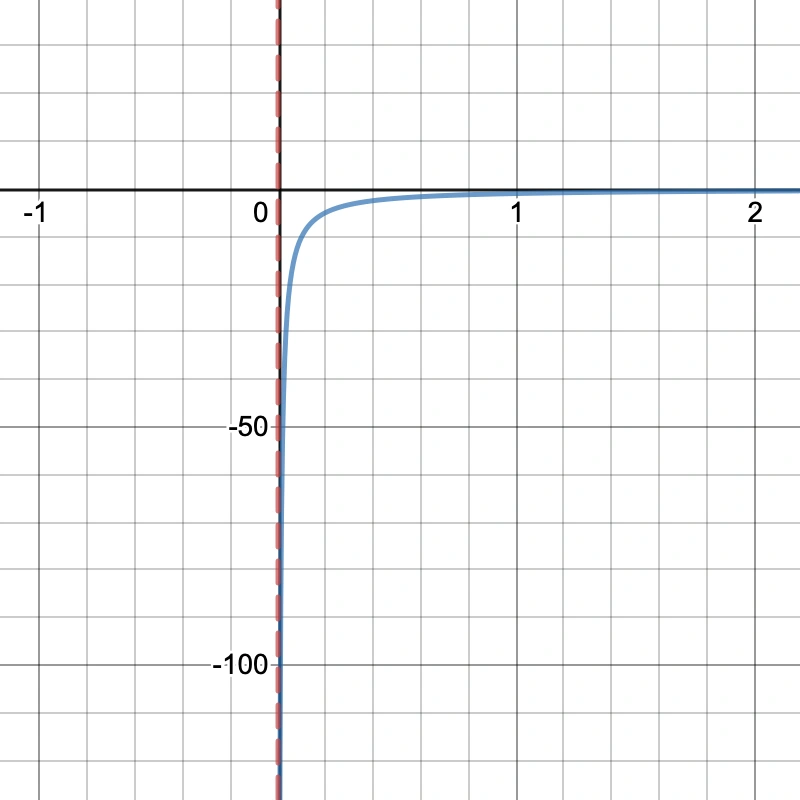
Remember that only one (or more) of the above conditions need to be true for it to be a vertical asymptote.
Epsilon Delta Definition
This is a first-year calculus definition which I will not go into depth about here, but the formal proof of a vertical asymptote would be as follows:
Or for vertical asymptotes that are approaching negative infinity:
If you do not understand the above, that is completely okay. It is basically saying that if I give you any arbitrarily large y value (in this case N) that you can find a segment of the domain so close to our vertical asymptote such that all elements within that interval of the domain would be greater than N.
Pro Tips
- Remember that the function can never cross/touch a vertical asymptote
- Make yourself comfortable graphing
- If you have difficulty graphing, you can always fall back to plotting points and by using the table function on your calculator to generate points quickly
- Make yourself comfortable solving quadratic and cubic equations
- Don’t forget to verify that the zero in the denominator is in fact an asymptote
- Don’t forget that some functions like have an infinite number of vertical asymptotes (it is a periodic function)
- Use a graphing calculator/desmos.com to verify your solutions
- Remember that vertical asymptote locations won’t usually be a part of your domain
Other Articles
How to find vertical asymptotes
THANKS FOR READING